Buy timber-wolf.eu ?
We are moving the project
timber-wolf.eu .
Are you interested in purchasing the domain
timber-wolf.eu ?
domain@kv-gmbh.de · 0541-91531010
Buy timber-wolf.eu ?
What are river variables and potential variables?
River variables are physical, chemical, and biological characteristics of a river that can be measured and monitored to assess its health and quality. These variables include parameters such as water temperature, pH levels, dissolved oxygen, nutrient concentrations, and the presence of pollutants. Potential variables are factors that can influence or impact the river variables, such as land use practices, urban development, agricultural runoff, and climate change. Understanding both river variables and potential variables is essential for effective river management and conservation efforts. **
'Forest or wildlife?'
Both forests and wildlife are important components of our ecosystem. Forests provide habitats for a wide variety of wildlife species, while wildlife plays a crucial role in maintaining the balance of the ecosystem. It is essential to protect both forests and wildlife to ensure the health and sustainability of our planet. Conservation efforts should focus on preserving both forests and wildlife to maintain biodiversity and promote a healthy environment for future generations. **

Similar search terms for Variables
Top-Angebote
Products related to Variables:
-
Skip's Garage Nevada Wolf Pack Cornhole Board Set"These boards are Regulation Sized 2x4 (24"" Wide x 48"" Long). They are built with Premium Wood 1x4 Frames and Solid Wood 2x3's for the legs. Both boards feature a 1/2"" Sanded Birch Plywood Surface for perfect playability."306,49 $*Shipping: 0,00 $Secure redirect to the provider
-
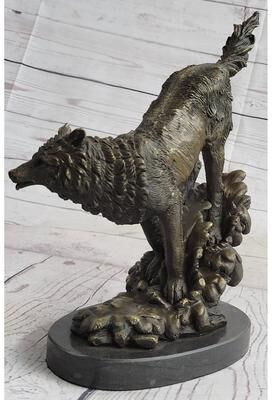
Bronzhaus Running Imitative Wolf Bronze Metal Statue Sculpture Wildlife Decor On Marble Base 9.5 Inches X 10 InchesCondition: This sculpture is in perfect condition Bronze Dimensions with Marble Base: Height 9.5 inches X Width 10 inches Marble Dimensions: Diameter 6 inches Height without base:8.5 inches Weight:8 LBS Inventory:78YDW1085687 Original or Reproduction:…295,49 $*Shipping: 0,00 $Secure redirect to the provider


-
What is the difference between primitive variables and reference variables?
Primitive variables store the actual value, such as numbers or characters, directly in memory. Reference variables, on the other hand, store a reference to an object in memory rather than the actual value. This means that when working with reference variables, you are actually working with the object that the reference points to, while with primitive variables, you are working directly with the value stored in memory. Additionally, primitive variables are allocated on the stack, while reference variables are allocated on the heap. **
-
When does the wolf howl?
Wolves typically howl to communicate with other pack members, establish territory boundaries, or to locate each other. They are known to howl more frequently during the evening and early morning hours, as this is when they are most active. Additionally, wolves may howl in response to certain sounds, such as sirens or other loud noises, which can trigger their instinct to howl in unison. **
-
What is the difference between ordinal scaled variables and ordinal variables?
Ordinal scaled variables are variables that have a specific order or ranking, but the intervals between the values are not necessarily equal. On the other hand, ordinal variables are variables that have categories with a natural order, but the numerical values assigned to them do not have any meaningful interpretation. In summary, ordinal scaled variables have meaningful numerical values with a specific order, while ordinal variables have categories with a natural order but lack meaningful numerical values. **
-
What are random variables?
Random variables are variables that can take on different values based on the outcome of a random event. They represent the possible outcomes of a random process and are used in probability theory and statistics to quantify uncertainty. Random variables can be discrete, taking on a finite number of values, or continuous, taking on any value within a range. They are essential for modeling and analyzing uncertain situations in various fields such as finance, engineering, and biology. **


What are reduced variables?
Reduced variables are a set of transformed variables that are used to simplify the analysis of a system or process. These variables are often obtained by scaling or normalizing the original variables to make them more manageable and easier to interpret. By using reduced variables, complex systems can be analyzed and understood more effectively, leading to better insights and decision-making. **
How do I solve an equation with form variables and solution variables?
To solve an equation with form variables and solution variables, you first need to isolate the solution variable on one side of the equation. This involves performing the necessary operations (addition, subtraction, multiplication, division) to move all other variables to the other side of the equation. Once you have isolated the solution variable, you can then solve for it by performing any additional operations needed to simplify the equation. Finally, you can substitute the solution back into the original equation to verify that it satisfies the equation. **
Top-Angebote
Products related to Variables:
-
Skip's Garage Nevada Wolf Pack Cornhole Board Set"These boards are Regulation Sized 2x4 (24"" Wide x 48"" Long). They are built with Premium Wood 1x4 Frames and Solid Wood 2x3's for the legs. Both boards feature a 1/2"" Sanded Birch Plywood Surface for perfect playability."306,49 $*Shipping: 0,00 $Secure redirect to the provider
-
What are river variables and potential variables?
River variables are physical, chemical, and biological characteristics of a river that can be measured and monitored to assess its health and quality. These variables include parameters such as water temperature, pH levels, dissolved oxygen, nutrient concentrations, and the presence of pollutants. Potential variables are factors that can influence or impact the river variables, such as land use practices, urban development, agricultural runoff, and climate change. Understanding both river variables and potential variables is essential for effective river management and conservation efforts. **
-
'Forest or wildlife?'
Both forests and wildlife are important components of our ecosystem. Forests provide habitats for a wide variety of wildlife species, while wildlife plays a crucial role in maintaining the balance of the ecosystem. It is essential to protect both forests and wildlife to ensure the health and sustainability of our planet. Conservation efforts should focus on preserving both forests and wildlife to maintain biodiversity and promote a healthy environment for future generations. **
-
What is the difference between primitive variables and reference variables?
Primitive variables store the actual value, such as numbers or characters, directly in memory. Reference variables, on the other hand, store a reference to an object in memory rather than the actual value. This means that when working with reference variables, you are actually working with the object that the reference points to, while with primitive variables, you are working directly with the value stored in memory. Additionally, primitive variables are allocated on the stack, while reference variables are allocated on the heap. **
-
When does the wolf howl?
Wolves typically howl to communicate with other pack members, establish territory boundaries, or to locate each other. They are known to howl more frequently during the evening and early morning hours, as this is when they are most active. Additionally, wolves may howl in response to certain sounds, such as sirens or other loud noises, which can trigger their instinct to howl in unison. **
Similar search terms for Variables
-
Bronzhaus Running Imitative Wolf Bronze Metal Statue Sculpture Wildlife Decor On Marble Base 9.5 Inches X 10 InchesCondition: This sculpture is in perfect condition Bronze Dimensions with Marble Base: Height 9.5 inches X Width 10 inches Marble Dimensions: Diameter 6 inches Height without base:8.5 inches Weight:8 LBS Inventory:78YDW1085687 Original or Reproduction:…295,49 $*Shipping: 0,00 $Secure redirect to the provider
-
What is the difference between ordinal scaled variables and ordinal variables?
Ordinal scaled variables are variables that have a specific order or ranking, but the intervals between the values are not necessarily equal. On the other hand, ordinal variables are variables that have categories with a natural order, but the numerical values assigned to them do not have any meaningful interpretation. In summary, ordinal scaled variables have meaningful numerical values with a specific order, while ordinal variables have categories with a natural order but lack meaningful numerical values. **
-
What are random variables?
Random variables are variables that can take on different values based on the outcome of a random event. They represent the possible outcomes of a random process and are used in probability theory and statistics to quantify uncertainty. Random variables can be discrete, taking on a finite number of values, or continuous, taking on any value within a range. They are essential for modeling and analyzing uncertain situations in various fields such as finance, engineering, and biology. **
-
What are reduced variables?
Reduced variables are a set of transformed variables that are used to simplify the analysis of a system or process. These variables are often obtained by scaling or normalizing the original variables to make them more manageable and easier to interpret. By using reduced variables, complex systems can be analyzed and understood more effectively, leading to better insights and decision-making. **
-
How do I solve an equation with form variables and solution variables?
To solve an equation with form variables and solution variables, you first need to isolate the solution variable on one side of the equation. This involves performing the necessary operations (addition, subtraction, multiplication, division) to move all other variables to the other side of the equation. Once you have isolated the solution variable, you can then solve for it by performing any additional operations needed to simplify the equation. Finally, you can substitute the solution back into the original equation to verify that it satisfies the equation. **
* All prices are inclusive of VAT and, if applicable, plus shipping costs. The offer information is based on the details provided by the respective shop and is updated through automated processes. Real-time updates do not occur, so deviations can occur in individual cases. ** Note: Parts of this content were created by AI.